Customers perceive the quality of a voice service and the reliability of a voice service based on many different experiences. Such experiences may be good or bad, but very often customers notice only the bad experience – obviously as they buy a service that is meant to work 100% at any time and from anywhere.
Bad experiences are often caused by network related problems:
• Calls with degraded voice quality
• Interrupted or Dropped calls or VoIP Dropped calls
• Unsuccessful call attempts
• Missed calls that did not ring or calls that were not signaled
Also end device related problems bring negative user experience:
• Empty battery on smartphone
• End device & VoIP Endpoint crashes
• Inability to setup 3 party conference call
For all voice operators, over-the-top (OTT) and legacy networks, these end-device related troubles are very important. Because in the end the customer does not care at all why something is not working! He will blame it on his voice service provider anyway.
As a result when considering the management of customer experience in next generation voice networks, it is very important to look beyond your own network infrastructure. Internet connections, utilization and network problems on the customers’ corporate LAN and end devices cause a large portion of the problems. So it would definitively not be a good idea to consider a service running well, simply because in one’s own network, all systems are up and running.
Instead operators also need to manage:
• End device & VoIP Endpoint firmware versions
• App/softphone software versions
• IP link quality characteristics
• Performance and problems at your Customers’ premises
• Error logs from the end device
Very often problems can be solved by optimizing configurations, codec settings, centralized firmware updates or pro-actively contacting the customer about up-coming problems with his device or software. So a tool is needed that see the endpoint or VoIP device as well as the network. But for all of that, a customer experience management system must provide the full set of information about how the customer truly perceives the service End-to-End.
When looking at customer experience management for VoIP networks, operators should choose a holistic approach and carefully select software solutions that are designed to look far beyond the usual scope and take care about the most important stakeholder in this game – the customer.
Friday, November 18, 2011
Monday, November 14, 2011
VoIP Service Assurance Available in the Cloud
Due to the huge amounts of traffic, telephone network analyzers are complex systems with beefy hardware requirements, complex setup procedures and the need for constant monitoring. For bigger networks the costs to run them is easily worth it, but for smaller networks deploying them might not be feasible. Be it for lack of time to learn how to run them, or because of a too big initial investment.
A recent trend in IT is the introduction of cloud services including for example cloud based service assurance or cloud based VoIP troubleshooting. In this setup the main part of the analyzer system is run in a central system, where it is managed by a knowledgeable and dedicated staff experienced in network monitoring and efficient VoIP troubleshooting. This leads to rapid deployment times and minimal investment to the point where one can just 'Try before you buy' so in other words, troubleshooting on Demand. The advantage of economy of scale brought by cloud based Network Management or cloud based Network Monitoring makes the most advanced analyzers available for even the smallest VoIP providers, leveling the playing field for all. You can even install it at the last minute in just a few seconds and use it when you have a problem
By deploying a VoIP traffic analysis in the cloud, you can usually achieve up-times far better than by using a complicated local setup and you can make sure that your running costs stay predictable. With today's technologies, security and data safety are a well-managed issue, all traffic streams being encrypted. A centralized software setup or hosted service assurance makes updates easier and your service provider is also able to diagnose and fix problems more efficiently by having complete access to the stack.
Cloud-based service assurance or network monitoring or VoIP troubleshooting can now be made available on a pay for use basis. Basically, you pay when you login to troubleshoot a problem on your network. If you do not have a problem, do not ever log in, you do not pay a cent. If you do login, for a small charge for one use, you fix the urgent problem that is troubling your customer. The return on investment for use of the network troubleshooting service is instant. The advantage of having paid the Per-Use fee is obvious to your management, because you have just fixed a difficult problem impacting your voice service. Keeping your customer, your customer and allowing you to move on to creating a new service or engineering your network
Cloud-based network monitoring gives you universal visibility and centralized and universal access to the analysis. One Installation and setup is so rapid it can be used on-demand when needed i.e. VoIP troubleshooting on Demand. In summation, cloud computing brings lots of advantages to VoIP service providers, (ITSP’s) who could not previously afford or justify the expense for a traffic analysis. With generally better availability, a transparent pricing structure (based on usage) and better support options, cloud solutions are surely an understandable trend in today's VoIP software stack market.
A recent trend in IT is the introduction of cloud services including for example cloud based service assurance or cloud based VoIP troubleshooting. In this setup the main part of the analyzer system is run in a central system, where it is managed by a knowledgeable and dedicated staff experienced in network monitoring and efficient VoIP troubleshooting. This leads to rapid deployment times and minimal investment to the point where one can just 'Try before you buy' so in other words, troubleshooting on Demand. The advantage of economy of scale brought by cloud based Network Management or cloud based Network Monitoring makes the most advanced analyzers available for even the smallest VoIP providers, leveling the playing field for all. You can even install it at the last minute in just a few seconds and use it when you have a problem
By deploying a VoIP traffic analysis in the cloud, you can usually achieve up-times far better than by using a complicated local setup and you can make sure that your running costs stay predictable. With today's technologies, security and data safety are a well-managed issue, all traffic streams being encrypted. A centralized software setup or hosted service assurance makes updates easier and your service provider is also able to diagnose and fix problems more efficiently by having complete access to the stack.
Cloud-based service assurance or network monitoring or VoIP troubleshooting can now be made available on a pay for use basis. Basically, you pay when you login to troubleshoot a problem on your network. If you do not have a problem, do not ever log in, you do not pay a cent. If you do login, for a small charge for one use, you fix the urgent problem that is troubling your customer. The return on investment for use of the network troubleshooting service is instant. The advantage of having paid the Per-Use fee is obvious to your management, because you have just fixed a difficult problem impacting your voice service. Keeping your customer, your customer and allowing you to move on to creating a new service or engineering your network
Cloud-based network monitoring gives you universal visibility and centralized and universal access to the analysis. One Installation and setup is so rapid it can be used on-demand when needed i.e. VoIP troubleshooting on Demand. In summation, cloud computing brings lots of advantages to VoIP service providers, (ITSP’s) who could not previously afford or justify the expense for a traffic analysis. With generally better availability, a transparent pricing structure (based on usage) and better support options, cloud solutions are surely an understandable trend in today's VoIP software stack market.
Thursday, November 10, 2011
Network Visibility Matters
“Knowledge is power” as the phrase goes and effectively, no matter what you want to achieve in your network management, a truly in-depth knowledge about your network processes is THE key asset when it comes to offering an excellent Customer Service and troubleshooting or to managing the overall network health with ease. Network knowledge and visibility allows you to find problems in minutes rather than hours, reducing operations costs and impressing your customer with rapid resolution of problems.
Today’s fast evolving telecommunication market with its multiple video & audio streams, a fast growing user base and geographically dispersed deployments is challenging and keeping an eye on the entire network doesn’t seem to be an easy task. Often, telecommunication operators are recurring to different systems or are not able to track back single network incidents which don’t provide a satisfying network visibility in the end.
First, choosing a solution that is able to process all signaling messages traversing the network in real-time and that instantly correlates multiple sites and network protocols is vital. Also, you will want to know the detailed status of the entire network health, the different application layers of the network, the end user devices and all the segments that a media stream is traversing through. A fully correlated end-to-end overview of all parts in the network can easily be provided when distributed agents are installed locally enabling a quick root-cause detection of network issues.
Talking about visibility, it is not only helpful to have an overall view of what is happening in the network, drilling-down into single calls, users, end devices and network devices is very valuable information as well. The perspective should be changed easily from a high-level overview for e.g. the operations department down to a granular and in-depth view of an individual user and its history which is helpful information for the customer service or support department. A filtering option will furthermore provide a high value to track users or to search for specific devices, numbers or customer groups, we which are known as realms.
A powerful network management tool should be able to provide past information about historical data, process data in real-time and should also allow a current and future proactive network management. Finally, a future-proof solution is a system which is easily integrated into an existing infrastructure reducing hereby the complexity, and instead of installing more hardware, it should be a lightweight solution that smoothly grows with the network.
A real-time intelligence software suite increases the ROI of LTE, IMS and VoIP deployments. It provides fixed and mobile operators a full end-to-end visibility and supports a multi-site and protocol call correlation.
Today’s fast evolving telecommunication market with its multiple video & audio streams, a fast growing user base and geographically dispersed deployments is challenging and keeping an eye on the entire network doesn’t seem to be an easy task. Often, telecommunication operators are recurring to different systems or are not able to track back single network incidents which don’t provide a satisfying network visibility in the end.
First, choosing a solution that is able to process all signaling messages traversing the network in real-time and that instantly correlates multiple sites and network protocols is vital. Also, you will want to know the detailed status of the entire network health, the different application layers of the network, the end user devices and all the segments that a media stream is traversing through. A fully correlated end-to-end overview of all parts in the network can easily be provided when distributed agents are installed locally enabling a quick root-cause detection of network issues.
Talking about visibility, it is not only helpful to have an overall view of what is happening in the network, drilling-down into single calls, users, end devices and network devices is very valuable information as well. The perspective should be changed easily from a high-level overview for e.g. the operations department down to a granular and in-depth view of an individual user and its history which is helpful information for the customer service or support department. A filtering option will furthermore provide a high value to track users or to search for specific devices, numbers or customer groups, we which are known as realms.
A powerful network management tool should be able to provide past information about historical data, process data in real-time and should also allow a current and future proactive network management. Finally, a future-proof solution is a system which is easily integrated into an existing infrastructure reducing hereby the complexity, and instead of installing more hardware, it should be a lightweight solution that smoothly grows with the network.
A real-time intelligence software suite increases the ROI of LTE, IMS and VoIP deployments. It provides fixed and mobile operators a full end-to-end visibility and supports a multi-site and protocol call correlation.
Sunday, November 6, 2011
Visualizing a VOIP Security Attack
Visualizing a cyber attack on a VOIP server from Ben Reardon, Dataviz Australia on Vimeo.
Prevent a VoIP security attack on your systems!
Wednesday, November 2, 2011
One Way Audio and the Inability to Receive Incoming VoIP Calls
As a VoIP Service Provider, you will no doubt have heard customers complaining about these two problems. In one case, the customer makes a call or Receives an incoming call and can hear their calling party. However, the calling party complains they cannot hear you. This is possibly because the VoIP Endpoint phone has a problem or there could be routing problem in the network.
More commonly, this is a problem with the firewall belonging to the enterprise. The enterprise network Administrator prefers not to allow incoming data sessions and for the VoIP session, the incoming RTP uses a different port to the outgoing RTP. The UDP port number used by RTP is negotiated by the SDP inside the SIP signaling at the commencement of the session or phone call. The actual details are subject to the implementation and configuration of the network and sometimes outgoing and incoming UDP ports for the RTP may be dissimilar.Re-configuring the firewall and ensuring that the RTP port is the same for incoming and outgoing RTP streams will rectify this problem.
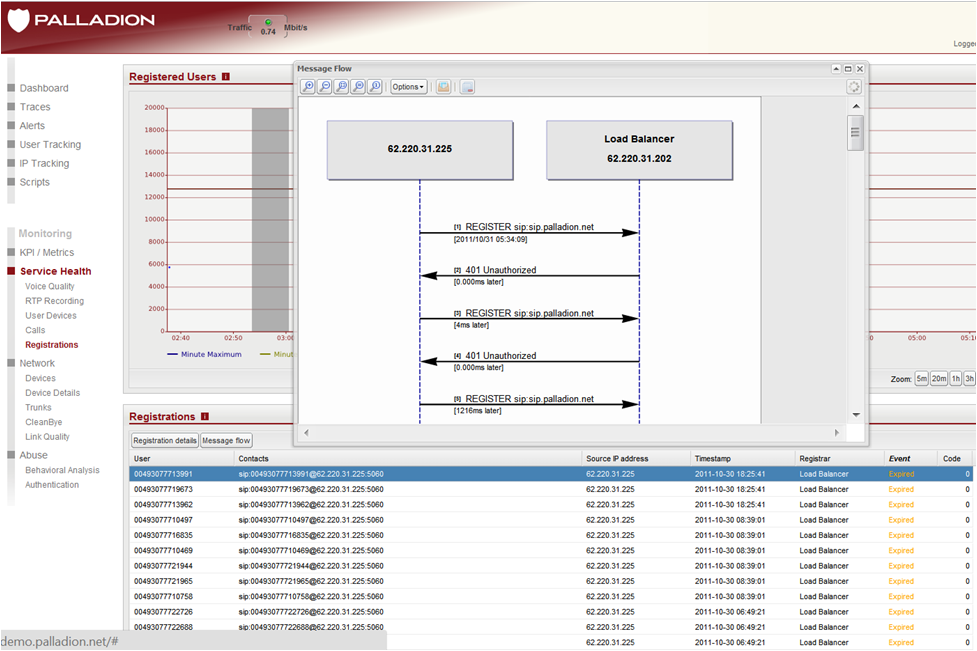
A similar problem, but more difficult to isolate, is where a customer complains they can make outgoing calls but their colleagues say they called your customer but their VoIP phone did not ring. The user can make outgoing calls. Failure of the incoming call is caused by REGISTRATION of their VoIP phone having expired on its registration server.
When a VoIP endpoint successfully registers on the registration server or the network, the registration server includes in its response, a time frame during which the REGISTRATION is valid. The VoIP endpoint/phone should RE-REGISTER with the registration server before half of the time period has expired.
Frequently, there is an imbalance between when the endpoint believes it should renew the registration and when the registration server expires the registration. A tool which can track the state of registration [New, Unauthorized, Expired or Gone] is invaluable in being able to find these stealth problems.Wireshark will show you the time and relationship between such REGISTRATION messages. However, an advanced intelligent Service Assurance tool such as Palladion will track the state of each endpoint, and also the firmware release of each endpoint, allowing you to find these anomalies in seconds.
Labels:
call,
calling party,
endpoint phone,
expired,
incoming call,
ladder diagram,
outgoing calls,
post dial delay,
quality managed services,
registration,
rtp,
service,
track state,
udp,
voip
Saturday, October 29, 2011
MOS [Mean Opinion Score] for High Definition or Wideband Telephony
Mean Opinion Score [MOS] is a scale from 1 to 5 indicating speech quality - 1 is bad and 5 is excellent. MOS test sessions comprise 15 to 25 people listening to speech files of good quality and of poor quality with impairments and scoring them subjectively. This subjective test process is specified in ITU-T P.800. In over 16 years where these tests have taken place, no statistically significant number of participants ever scored any speech recording as being excellent or 5.0. The highest score typically obtained in any test was 4.5.
High Definition or Wideband Telephony speech uses the new POLQA speech quality metric for objective protection of MOS. The old PESQ algorithm has been used for narrowband telephony since it was approved in 2000. It is desirable to use the same scale so that laboratories can compare new results for wideband telephony with their old PESQ database. However, the question of human expectation comes into play because all these objective measurements performed by computers must correlate or predict subjective experience. If you watch a video on your smart phone, you might consider the picture quality as being good. Your expectations are put in the context of the small screen and the convenience of the video being played on a handheld smartphone. If you would give you the same video on your brand-new expensive high-definition 1080P TV, you would be very disappointed even if the pixel resolution had been scaled to the 62 inches screen size. Your expectation of quality is tempered to the format in which you are viewing it.
Similarly with speech and audio. If you were to participate in a MOS test and invited into a studio where there were high fidelity speakers, orchestral classical music playing and told and asked to rate the quality of the High Definition speech you are about to hear, your expectations would be set high and you'd be more critical. You would score the audio lower than if you had been asked to rate the speech quality of your most recent cellular phone call.
POLQA offers two scales, the narrowband scale and the super wideband scale. Super wideband telephony reaches 14 kHz analog audio frequency. The narrowband focus scale maps directly onto the old desk scale and exploits the higher scores not given by test participants in narrowband tests.
• NB: Maximum MOS value 4.25
• WB: Maximum MOS value 4.5
• SWB: Maximum MOS value 4.75
So a score of 4.5, on the narrowband POLQA scale is experimentally the best value you will ever obtain with wideband telephony equipment. You could conceivably measure a MOS value of 4.75 if you were measuring super wideband equipment.
In future years, the industry will migrate exclusively to using the super wideband POLQA scale as soon as users' expectations always expect high-definition or hi-fi quality to the communications audio.
The picture shows the iLBC codec measured measuring 4.21 narrowband focus scale.
For more information on making PESQ and POLQA measurements, ensure you contact only renown and well-respected test vendors because the science of speech quality measurements requires expertise and experience in many different areas audio, analog electronics as well as computing. It is easy to make a measurement but care is required to ensure that measurement is accurate and correlates to human subjective experience
The most trusted vendor for speech quality metrics is Malden Electronics, available in USA through Teraquant Corporation – www.teraquant.com
See use in http://technorati.com - X84QTD2E9BS6
High Definition or Wideband Telephony speech uses the new POLQA speech quality metric for objective protection of MOS. The old PESQ algorithm has been used for narrowband telephony since it was approved in 2000. It is desirable to use the same scale so that laboratories can compare new results for wideband telephony with their old PESQ database. However, the question of human expectation comes into play because all these objective measurements performed by computers must correlate or predict subjective experience. If you watch a video on your smart phone, you might consider the picture quality as being good. Your expectations are put in the context of the small screen and the convenience of the video being played on a handheld smartphone. If you would give you the same video on your brand-new expensive high-definition 1080P TV, you would be very disappointed even if the pixel resolution had been scaled to the 62 inches screen size. Your expectation of quality is tempered to the format in which you are viewing it.
Similarly with speech and audio. If you were to participate in a MOS test and invited into a studio where there were high fidelity speakers, orchestral classical music playing and told and asked to rate the quality of the High Definition speech you are about to hear, your expectations would be set high and you'd be more critical. You would score the audio lower than if you had been asked to rate the speech quality of your most recent cellular phone call.
POLQA offers two scales, the narrowband scale and the super wideband scale. Super wideband telephony reaches 14 kHz analog audio frequency. The narrowband focus scale maps directly onto the old desk scale and exploits the higher scores not given by test participants in narrowband tests.
• NB: Maximum MOS value 4.25
• WB: Maximum MOS value 4.5
• SWB: Maximum MOS value 4.75
So a score of 4.5, on the narrowband POLQA scale is experimentally the best value you will ever obtain with wideband telephony equipment. You could conceivably measure a MOS value of 4.75 if you were measuring super wideband equipment.
In future years, the industry will migrate exclusively to using the super wideband POLQA scale as soon as users' expectations always expect high-definition or hi-fi quality to the communications audio.
The picture shows the iLBC codec measured measuring 4.21 narrowband focus scale.
For more information on making PESQ and POLQA measurements, ensure you contact only renown and well-respected test vendors because the science of speech quality measurements requires expertise and experience in many different areas audio, analog electronics as well as computing. It is easy to make a measurement but care is required to ensure that measurement is accurate and correlates to human subjective experience
The most trusted vendor for speech quality metrics is Malden Electronics, available in USA through Teraquant Corporation – www.teraquant.com
See use in http://technorati.com - X84QTD2E9BS6
Tuesday, October 25, 2011
Can You Hear Me Now?
PolQA is the new ITU-T Standard for Speech Quality Measurement which embraces Wideband or High Definition Telephony.
“Can you hear me now?”
We’ve all heard the refrain. How often have you been on a mobile phone & not been able to hear your calling party? How often have you experienced drop-outs on a VoIP call and missed that vital clue, that's important piece of information the caller mentioned which allowed you to understand their needs. May be you lost the business as a result. Good clear speech quality means productivity, both in business and in personal life. Everyone is critically busy these days and if you have to ask folks to repeat themselves, you waste time, first-rate meaningful conversation and miss information.
The existing telephony network uses 200-34000Hz analog bandwidth, digitized at a sampling rate of 8kbps. 8 bits of vertical resolution multiplied by 8kbps gives the traditional 64kbps bandwidth required for a voice channel. Compression by codecs such as G.729 and iLBC VoIP and specifically iSAC for Skype and GSM-FR & EVRC for wireless transmits narrowband traditional telephony at data rates as low as 4kbps.
So now we can compress voice sports to very low bandwidths and at the same time we have broadband Internet. so what can we do to improve speech quality.
Wideband or High Definition Telephony technology is now appearing in VoIP networks and wireless networks using voice codecs such as G.722 and WB-AMR. This provides speech with an analog bandwidth up to 7kHz and gives a richer listening experience. Those problems you currently have trying to recognize which of your young nieces or nephews is speaking to you is due to high frequencies filtered out with narrowband telephony. Wideband telephony will reinstate these, enriching your telephone conversation experience and improving productivity through speech clarity. This technology will eventually send telephony speech all the way up to 20 kHz, the limit of human hearing, equivalent to hi-fi music systems.
3gpp release 5 introduces AMR-WB codec which gives enhanced speech quality using data rates of only 16kbps. So wideband telephony or high definition telephony is being made available to wireless cellular networks.
Tools to Automatically Measure Speech Quality
Determining the subjective speech quality of a transmission system has always been an expensive and laborious process. The tool described in ITU-T Rec. P.862 Perceptual Evaluation of Speech Quality – PESQ provides a rapid and repeatable result in a few moments. PESQ is an objective measurement tool i.e. a computer measures the quality of the received audio in relation to the audio that was transmitted. PESQ predicts or has a very accurate close correlation to the results of subjective listening tests [i.e. human beings listening to speech files] On telephony systems. The resulting quality score is analogous to the subjective “Mean Opinion Score” (MOS) measured using panel tests according to ITU-T P.800. Strictly speaking, MOS is a score derived from human subjective testing. The PESQ scores are calibrated using a large database of subjective tests.
The ITU-T selection process that resulted in the standardization of PESQ involved a wide range of conditions, with demanding correlation requirements set to ensure that it has good performance in assessing conventional fixed and mobile networks and packet-based transmission systems.
Since ITU-T Rec. P.862 was originally released in 2000, further mappings of the PESQ score have been created. PESQ-LQ modified the score to improve correlation with subjective test results at the high and low ends of the scale where the raw PESQ score was found to be less accurate. A new mapping described in ITU-T Rec. P.862.1 was been released that further modified the raw score and correlated better to subjective testing.
PESQ takes into account coding distortions, errors, packet loss, delay and variable delay, and filtering in analogue network components. The user interfaces have been designed to provide a simple access to this powerful algorithm, either directly from the analogue connection or from speech files recorded elsewhere.
The performance of a network or a network element can be fully characterized using high quality analog test equipment and PESQ. High quality analog interfaces are needed because the test equipment itself very easily introduces impairments which are included in the measurement and drank the desk score lower than should be measured for the system under test or network element. Whilst it is possible to use phonetically balanced sentences and other test patterns, accurate and repeatable measurements of the active speech level, activity, delay, echo, noise and speech quality can be obtained quickly using artificial speech test stimulus in different languages, which comprehensively tests all voice sounds the codec may be incident with, but at the same time achieves the process quickly in a time efficient way. A graphical mapping of the errors provides a useful insight into how the signal has been degraded and exactly what kind of sounds course the codec core system and test problems.
Since the launch of PESQ in 2000, there have been many advances in codec design. Unfortunately, PESQ was not trained on these later designs and can produce scores that are lower than expected from subjective tests. Time-warping and voice quality enhancement techniques are particularly difficult for PESQ. The ITU agreed on a new standard, P.863 POLQA, in 2010. POLQA addresses many of the issues and produces reliable scores for codecs, both old and new. POLQA is Now available on a couple of speech quality measurement platforms but Malden is the only platform that provides a quiet, high-quality analog front-end and the only platform to be recommended.
“Can you hear me now?”
We’ve all heard the refrain. How often have you been on a mobile phone & not been able to hear your calling party? How often have you experienced drop-outs on a VoIP call and missed that vital clue, that's important piece of information the caller mentioned which allowed you to understand their needs. May be you lost the business as a result. Good clear speech quality means productivity, both in business and in personal life. Everyone is critically busy these days and if you have to ask folks to repeat themselves, you waste time, first-rate meaningful conversation and miss information.
The existing telephony network uses 200-34000Hz analog bandwidth, digitized at a sampling rate of 8kbps. 8 bits of vertical resolution multiplied by 8kbps gives the traditional 64kbps bandwidth required for a voice channel. Compression by codecs such as G.729 and iLBC VoIP and specifically iSAC for Skype and GSM-FR & EVRC for wireless transmits narrowband traditional telephony at data rates as low as 4kbps.
So now we can compress voice sports to very low bandwidths and at the same time we have broadband Internet. so what can we do to improve speech quality.
Wideband or High Definition Telephony technology is now appearing in VoIP networks and wireless networks using voice codecs such as G.722 and WB-AMR. This provides speech with an analog bandwidth up to 7kHz and gives a richer listening experience. Those problems you currently have trying to recognize which of your young nieces or nephews is speaking to you is due to high frequencies filtered out with narrowband telephony. Wideband telephony will reinstate these, enriching your telephone conversation experience and improving productivity through speech clarity. This technology will eventually send telephony speech all the way up to 20 kHz, the limit of human hearing, equivalent to hi-fi music systems.
3gpp release 5 introduces AMR-WB codec which gives enhanced speech quality using data rates of only 16kbps. So wideband telephony or high definition telephony is being made available to wireless cellular networks.
Tools to Automatically Measure Speech Quality
Determining the subjective speech quality of a transmission system has always been an expensive and laborious process. The tool described in ITU-T Rec. P.862 Perceptual Evaluation of Speech Quality – PESQ provides a rapid and repeatable result in a few moments. PESQ is an objective measurement tool i.e. a computer measures the quality of the received audio in relation to the audio that was transmitted. PESQ predicts or has a very accurate close correlation to the results of subjective listening tests [i.e. human beings listening to speech files] On telephony systems. The resulting quality score is analogous to the subjective “Mean Opinion Score” (MOS) measured using panel tests according to ITU-T P.800. Strictly speaking, MOS is a score derived from human subjective testing. The PESQ scores are calibrated using a large database of subjective tests.
The ITU-T selection process that resulted in the standardization of PESQ involved a wide range of conditions, with demanding correlation requirements set to ensure that it has good performance in assessing conventional fixed and mobile networks and packet-based transmission systems.
Since ITU-T Rec. P.862 was originally released in 2000, further mappings of the PESQ score have been created. PESQ-LQ modified the score to improve correlation with subjective test results at the high and low ends of the scale where the raw PESQ score was found to be less accurate. A new mapping described in ITU-T Rec. P.862.1 was been released that further modified the raw score and correlated better to subjective testing.
![]() |
| PESQ Shortcomings - Time Warping |
PESQ takes into account coding distortions, errors, packet loss, delay and variable delay, and filtering in analogue network components. The user interfaces have been designed to provide a simple access to this powerful algorithm, either directly from the analogue connection or from speech files recorded elsewhere.
![]() |
| PESQ Shortcomings Noise Reduction: (Subjective > PESQ) |
Since the launch of PESQ in 2000, there have been many advances in codec design. Unfortunately, PESQ was not trained on these later designs and can produce scores that are lower than expected from subjective tests. Time-warping and voice quality enhancement techniques are particularly difficult for PESQ. The ITU agreed on a new standard, P.863 POLQA, in 2010. POLQA addresses many of the issues and produces reliable scores for codecs, both old and new. POLQA is Now available on a couple of speech quality measurement platforms but Malden is the only platform that provides a quiet, high-quality analog front-end and the only platform to be recommended.
Subscribe to:
Posts (Atom)